
Our Approach
Understanding our Challenges in Workforce Development
Fragmented Collaboration – Lack of coordination across workforce development organizations leads to duplication of efforts
Inefficient Referrals – Manually managed referrals between organizations cause delays and gaps in service delivery
Limited Follow-up – Insufficient capabilities to track client outcomes over time leads to low program completion rates
Financial Constraints – Limited funding for programs and staffing constrains service capacity and quality
Duplication – Multiple providers offering similar services
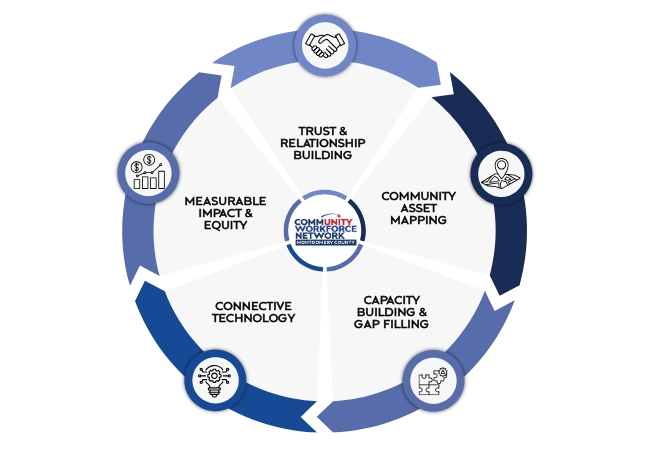
Our Systems Building Model structured by our top priorities
Priority One
Priority Two
Priority Three
Priority Four
Priority Five
Trust & Relationship Building
DEVELOP TRUST
Build trust by demonstrating integrity, reliability, and respect through consistent actions and follow‑through.
ALIGNED VISION & GOALS
Create alignment by establishing a shared vision and clearly defined goals that guide priorities and decision‑making.
FOSTER OPEN COMMUNICATION
Encourage open communication by creating a safe environment where ideas, feedback, and concerns can be shared transparently and constructively.
Community Asset Mapping
IDENTIFYING COMMUNITY ASSETS
Recognize and map existing strengths, resources, and capabilities within the community to build an informed foundation for action.
GAP ANALYSIS
Assess current resources and outcomes against desired goals to pinpoint unmet needs and opportunities for improvement.
LEVERAGING PARTNERSHIPS
Maximize impact by strategically engaging partners whose expertise, resources, or influence complement and strengthen shared objectives.
BUILDING CONNECTIONS
Strengthen collaboration and collective impact by cultivating meaningful relationships across stakeholders, organizations, and community members.
Capacity Building & Gap Filling
COMMUNITY WORKFORCE NETWORK
Expand community‑based training opportunities for underserved populations by through strategic membership network of workforce development providers.
EXPANDED CERTIFICATION PROGRAMS
Scale a virtual tools such SkillUP Montgomery & Career Coach Coach tools to enhance access to professional skills and certification training programs.
CUSTOMIZED PROGRAMMING
Design and implement targeted programs that address the unique needs of justice‑impacted individuals, people with disabilities, young adults, and other underserved demographics.
DEVELOPMENT
Partner with Community Workforce Network members to secure new funding sources to expand the workforce system’s capacity.
DEVELOP EVIDENCE-BASED STANDARD OPERATING PROCEDURES
Establish standardized, evidence‑based processes to ensure universal access, consistency, and accountability.
EMPHASIZE CLIENT-CENTRIC PARTNERSHIPS
Use data and a deep understanding of client goals to build partnerships that provide personalized, tailored services.
IMPLEMENT CONTINUOUS IMPROVEMENT PROCESSES
Continuously collect and analyze outcome data to assess performance, identify opportunities for growth, and refine systems and practices over time.
Connective Technology
SUPPORT & MAXIMIZE TECHNOLOGY
Leverage technology in an intelligent, innovative, and intentional way to enhance coordination, communication, efficiency, and service delivery.
KNOWLEDGE & AWARENESS
Maintain a strong understanding of clients’ immediate needs provider requirements to ensure accurate and suitable referrals.
TRACKING RESULTS
Systematically track referral outcomes by partner agency, staff, and service type to measure effectiveness and inform continuous improvement.
Measurable Impact & Equity
MEASURE EFFORTS TO OUTCOMES
Focus on measuring operational practices as well as meaningful results that lead to real‑world impact.
ALIGN METRICS TO STRATEGY
Ensure performance metrics directly support strategic goals.
AUTOMATE DATA COLLECTION
Use technology such as surveys, forms, and analytics to streamline data collection and reduce reliance on manual processes.
MAKE DATA VISIBLE
Present data through dashboards, reports, and visual tools that make insights easy to access, understand, and act upon.
DISAGGREGATE DATA
Break down performance metrics by demographic factors to identify disparities and uncover equity gaps.
COMMUNITY FEEDBACK
Incorporate feedback from marginalized communities into evaluation design to ensure relevance, accountability, and inclusivity.
PROGRESS METRICS
Track progress toward equity goals by measuring change over time rather than relying solely on overall averages.