

Language discrimination at work means being treated unfairly because of how you speak: your accent, your first language, or how well you speak English. U.S. law does not protect language as a category by itself. It protects you through national origin and related rules, which means an employer may set language requirements only when the job genuinely calls for them. Below we explain where the line falls on accents, English-only rules and immigration status, and what to do if you think it has been crossed.
TL;DR
- An employer may act on an accent only if it materially interferes with doing the job. Otherwise, treating you differently or harassing you because of it can be national origin discrimination.
- English-only rules must be tied to business necessity, such as safety or communicating with customers, and be narrowly tailored. A blanket rule that covers breaks is the classic problem.
- Citizenship and immigration status are covered by a separate law, the Immigration and Nationality Act, with its own enforcement office and its own 180-day filing window.
- Write down what happened, when, and who saw it. Deadlines are short, so act early.
Table of Contents
- What counts as language discrimination
- Accent discrimination: when an accent can and cannot matter
- English-only policies: the limits
- Citizenship and immigration status discrimination
- Retaliation is its own violation
- Documenting what happened
- Reporting, deadlines and remedies
- Our perspective
- Support free, plain-language rights information
- FAQ
- Sources
What counts as language discrimination
Language is closely tied to who we are and where we come from. Courts and federal agencies treat it that way. The Equal Employment Opportunity Commission (EEOC) says that linguistic characteristics such as accent are intertwined with national origin. For that reason, it asks courts to take a “searching look” at employment decisions that rely on them, so that the decision rests on real job performance and not on bias.
In practice, language discrimination at work usually looks like one of these:
- Not hiring, promoting or assigning someone because of an accent, when the accent has no effect on the work.
- Mocking someone’s accent or pronunciation, or using slurs about their background.
- Enforcing an English-only rule that is broader than the job requires.
- Requiring fluency or a particular “American” way of speaking for a job that does not depend on it.
- Treating workers differently because of citizenship or immigration status.
None of this means every comment or every language requirement is unlawful. The law asks whether the language rule or the reaction to an accent is actually connected to the work. That question shapes everything that follows.
Accent discrimination: when an accent can and cannot matter
An accent is not a performance problem on its own. According to the EEOC, an employer may base a job decision on an accent if it would materially interfere with the ability to perform the job. If it does not, the employer may not treat you differently or harass you because of it.
The difference is easiest to see in examples.
| Situation | Likely concern |
|---|---|
| A call center agent is passed over for promotion because customers “might not like” a foreign accent, though the agent is understood without difficulty and meets every performance target | Decision rests on bias and preference, not on the job |
| A safety trainer is asked to improve clarity because trainees repeatedly cannot understand critical instructions | Employer may point to a real job-related communication need |
| Coworkers imitate a colleague’s accent and the manager laughs along | Possible harassment based on national origin |
| A candidate is rejected because of an accent, with no assessment of how well they communicate in the role | Hiring decision not tied to job requirements |
Two points matter in the first row. Customer preference does not usually excuse a decision that would otherwise be biased. And the best evidence is almost always performance: reviews, targets met, and the fact that people understood you.
Harassment about how you speak
Harassment is a separate route from a denied job or promotion. Ethnic slurs, mocking accents and similar conduct are unlawful when severe or pervasive enough to create a hostile work environment. A single joke may not meet that bar. A pattern of comments, especially from a supervisor, may. If you are living with that kind of pattern, our guide on workplace bullying laws explains where bullying ends and unlawful harassment begins.
English-only policies: the limits
Many workers search for this because a manager has told them to stop speaking their first language. Such a rule is not automatically illegal, but it is closely scrutinized.
The U.S. Department of Labor explains that employers may require English only when it is justified by business necessity, such as for safety, efficiency, or communicating with English-only speakers, and when the rule is narrowly tailored to those needs. The same page says a policy may be unlawful if:
- it applies at all times, including breaks and lunch;
- it is not based on actual business necessity; or
- it was adopted for discriminatory reasons, to exclude particular groups.
The EEOC adds that language-restrictive rules cannot be used to promote mere business convenience. They must be job-related. An employer who dislikes hearing other languages in the break room, or whose customers or other employees feel uncomfortable, has not shown a business necessity.
What a lawful rule looks like
A narrow rule might say that during a surgery, on an active construction site or when a pilot is communicating with air traffic control, workers must use a shared language so instructions are understood. It applies to those moments only, and the reason is stated. A rule that says “English only in the building” with no explanation does not fit that description.
What employers should keep on file
An employer that adopts a language rule should be able to explain the reason in writing, who the rule applies to, and when it applies. Good records of the business reasons behind a rule protect workers and employers alike, since they make it clear the rule is about safety or communication and not preference. Nonprofit employers in particular can look at employment records nonprofits should keep as a starting point for documentation practices.
If you are subject to a rule you believe is too broad, do not simply stop speaking up. Ask for the policy in writing, note when and how it was explained to you, and keep a record of any discipline tied to it.
Citizenship and immigration status discrimination
This is where language and national origin overlap with a different statute. Title VII addresses national origin. A separate law, the Immigration and Nationality Act (INA), addresses citizenship status and certain immigration-related practices.
Under 8 U.S.C. § 1324b, it is unlawful for an employer to make hiring or firing decisions based on someone’s citizenship or immigration status. The law protects “protected individuals,” which includes U.S. citizens, nationals, refugees, asylees and recent lawful permanent residents.
How it differs from national origin discrimination
- National origin discrimination is about where you or your family come from, or the ethnic and linguistic traits associated with it, such as an accent. It is enforced by the EEOC.
- Citizenship status discrimination is about your legal status: whether you are a citizen, a refugee, an asylee, a green card holder or hold a temporary visa. It is enforced by the Department of Justice’s Immigrant and Employee Rights Section (IER).
The two can both be present in one situation. A worker with an accent who is also asked for extra documents because of how they sound may have a claim under both. The statute itself also bars employers from limiting jobs to U.S. citizens unless a legal requirement exists, and from preferring temporary visa holders over equally qualified protected individuals, as the text of the law shows.
IRCA, the Immigration Reform and Control Act of 1986, is the law that created these provisions and the employment eligibility verification process. If someone asks for specific documents when you start a job, or rejects valid documents that look different from what they expected, that is the kind of situation the IER handles.
Retaliation is its own violation
Workers often stay quiet because they fear losing their job. The law anticipates this. Retaliation against an employee for opposing discrimination, filing a charge or taking part in an investigation is prohibited under both Title VII and the INA. That means you can raise a concern, support a coworker or file a charge without it being a lawful basis for punishment. If your hours are cut or you are disciplined soon after complaining, write down the dates. The sequence matters.
Documenting what happened
Strong claims are built on clear, early records. State agencies advise employees to keep a contemporaneous diary at home and to put complaints in writing; the New York State Division of Human Rights guide says exactly that. It is good advice anywhere in the country.
What to record:
- The date, time and place of each incident.
- The exact words used, as closely as you remember them.
- Who was present and who may have heard.
- How the incident affected your work, schedule, pay or assignments.
- Any written policy or message, such as an email or text about language.
Keep copies somewhere personal, not only on a work device. Our guide on how to document workplace harassment evidence walks through what to save and how to organize it.
Reporting, deadlines and remedies
Deadlines are where good cases are lost, so this section matters.
Federal deadlines
For national origin discrimination, you generally file a charge with the EEOC before going to court. The usual filing window is 180 days from the act, and it can extend to 300 days where a state or local agency also covers the claim. Because the rules differ by employer type and location, confirm your own deadline on our EEOC charge filing guide. After the EEOC process ends, you receive a right-to-sue letter, and that letter states how long you have to file a lawsuit. Read it the day it arrives.
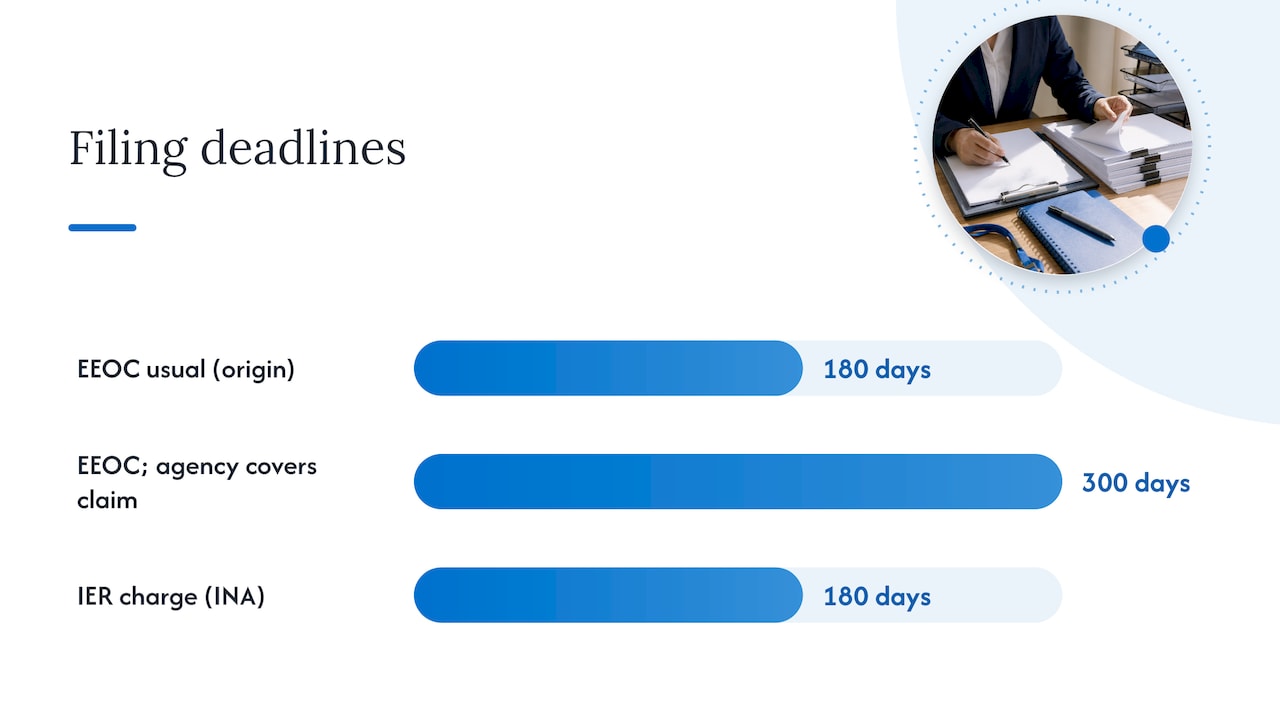
For citizenship status discrimination under the INA, a charge goes to the Department of Justice’s IER and must be filed within 180 days of the alleged act.
State agencies
Many states have their own fair employment agencies and laws, and some are broader than federal law. New York is one example. Its Division of Human Rights guide states that the deadline is three years for acts on or after February 15, 2024, and that remedies can include back pay, compensatory damages and reinstatement. The same guide notes you need not complain to your employer before filing with the Division, though not following internal procedures may hurt your case. Check your own state agency’s website, since time limits and remedies vary from place to place.
Practical order of steps
- Write down what happened, now.
- Read the employer’s policy and complaint procedure.
- Report in writing to HR or a manager, and keep a copy.
- File with the right agency before your deadline: EEOC or state agency for national origin, IER for citizenship status.
- Talk to an employment attorney, many of whom offer an initial consultation, especially before any deadline gets close.
For a fuller walk-through, see our workplace discrimination complaint process.
Our perspective
We built Workplace Fairness to connect the knowledge of employment rights attorneys with the people who live these issues every day. Language discrimination is one of the clearest examples of why that matters.
Most workers who are told to stop speaking Spanish in the break room, or whose accent is mocked in a meeting, do not know whether the law is on their side. They are often right to wonder. The legal tests turn on business necessity and job performance, and those are questions of fact, not slogans. When you understand the test, you can see whether your situation fits it.
We believe equitable workplaces are built when employees know their rights and employers know their obligations. Clear, plain-language information is the first step. Our materials are designed to explain the process, from documenting an incident to choosing the right agency, without legal jargon, so you can decide your next move with confidence.
Resilience matters, but no one should have to rely on it alone. Collective awareness leads to better policies and, over time, to change in the law itself.
Max
Support free, plain-language rights information
Workplace Fairness is a free resource, and it runs on the support of readers who believe workers should understand their rights. If this guide helped, you can join as a member from $25 per year and help us keep our guides current and open to everyone.
See how to become a member. To keep reading, our overview of workplace discrimination types and the guide to employee rights cover related protections, and our piece on dress code discrimination addresses another area where appearance rules and identity overlap.
FAQ
Is it illegal to discriminate against someone for their accent?
It can be. An employer may not treat you differently or harass you because of an accent unless the accent materially interferes with doing the job, according to the EEOC. The question is whether the accent affects actual performance.
Can my employer make me speak English at work?
Sometimes. A rule must be justified by business necessity, such as safety or communicating with English-only speakers, and be narrowly tailored, per the Department of Labor. A rule that applies all day, including breaks, is more likely to be unlawful.
What is the difference between national origin and citizenship status discrimination?
National origin discrimination concerns your ancestry, ethnicity or traits like an accent, and goes to the EEOC. Citizenship status discrimination concerns whether you are a citizen or what immigration status you hold, and falls under the Immigration and Nationality Act, with charges filed with the Justice Department’s IER.
How long do I have to file a complaint?
For citizenship status claims, you have 180 days to file with the IER. National origin claims usually go to the EEOC or a state agency, and the time limit depends on your location and employer. Check our EEOC filing guide or your state agency right away.
Can I be fired for complaining about language discrimination?
No. Retaliation for opposing discrimination, filing a charge or taking part in an investigation is prohibited. Document the timing of any change in how you are treated after you complain.
Sources
- EEOC: National Origin Discrimination FAQs
- EEOC Enforcement Guidance on National Origin Discrimination
- U.S. Department of Labor: English-Only Rules
- 8 U.S. Code § 1324b, Cornell Legal Information Institute
- Department of Justice: IER Frequently Asked Questions
- New York State Division of Human Rights: Basic Guide to Employment
Recommended
- Employment Discrimination Rights
- Dress Code Discrimination in The Workplace
- Employee Rights Explained: Your 2026 U.S. Legal Guide
- Workplace Bullying Laws in the U.S.: What Protects You
The post Language Discrimination at Work: Your Rights in the U.S. appeared first on Workplace Fairness, Empower Workers.